Qing Governors and Their Provinces by Guy R. Kent
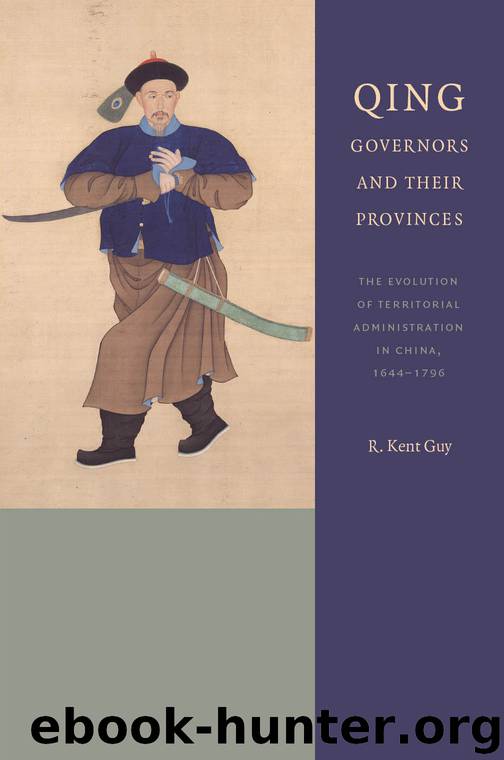
Author:Guy, R. Kent
Language: eng
Format: epub
Publisher: University of Washington Press
Published: 2013-07-11T16:00:00+00:00
Accommodation: The Civilian Governors of Jiangsu
Having created two provinces in the Yangzi delta, the Qing set about to create two different administrative orders, and in this endeavor, Qing accommodation to the enduring realities of the delta was most apparent. Much of this accommodation was accomplished with different sorts of appointments. Anhui became a stopping place on official journeys through China’s heartland. Governors of Anhui were often recently promoted and came to Anqing from all the provincial capitals in China except Guizhou. At the conclusion of terms that ranged from several months to nearly five years, they were generally transferred laterally to other governorships, often in other regions. As relative newcomers to the corps of governors, Anhui governors were probably somewhat weaker than their colleagues and were certainly weaker than their neighbors in Suzhou. Southern Anhui, where the provincial capital was located, was one of the most heavily commercialized regions of China and home to a very powerful merchant elite. In other parts of China where mercantile elites effectively organized economic and social life, for instance, Hankow, the Qing contented itself with a relatively weak political presence. This may have been the case in Anqing as well. The dynasty’s relations with the southern Anhui merchants were more likely to have been managed by the Lianghuai salt commissioner than by the provincial governor.
Jiangsu, in contrast, became one of the most specialized provincial postings, with frequent internal promotions and many intraregional transfers. Of those promoted to governor in Jiangsu, 66 percent were lieutenant governors there at the time of their promotions, and 46.9 percent of those promoted and transferred to the governorship of Jiangsu held posts in the lower Yangzi region at the time of their promotion. Only Yunnan and Shaanxi were comparably specialized. But in those places, it was quite clearly military need that dictated patterns of appointment. Jiangsu was the preeminent site of civilian rule in the delta. In a world where military and civilian portfolios so often overlapped, it may be problematic to insist on a distinction between the two realms. Yet if such a distinction existed anywhere in seventeenth-century China, it was in Jiangsu, where governors and governors-general occupied two different cities, located a hundred miles apart.
After the disasters of the early 1660s, it took the Qing the better part of a generation to build a stable civilian administration at Suzhou. But when the task was accomplished, by the last years of the seventeenth century, most of the lower Yangzi elite had at least accepted Qing rule and routine, and the dynasty, for its part, had rebuilt much of the hydraulic infrastructure on which the economy of the region depended. Much of this was accomplished by a remarkable series of governors in whose lives the themes of intellectual accomplishment, public service, and the creative reframing of loyalties were intertwined.
It took nearly fifteen years for the dynasty to make a decisive commitment to civilian rule in the lower Yangzi valley. When the Kangxi emperor established procedures for promoting finance commissioners
Download
This site does not store any files on its server. We only index and link to content provided by other sites. Please contact the content providers to delete copyright contents if any and email us, we'll remove relevant links or contents immediately.
| Anthropology | Archaeology |
| Philosophy | Politics & Government |
| Social Sciences | Sociology |
| Women's Studies |
The Secret History by Donna Tartt(19294)
The Social Justice Warrior Handbook by Lisa De Pasquale(12224)
Thirteen Reasons Why by Jay Asher(8995)
This Is How You Lose Her by Junot Diaz(6955)
Weapons of Math Destruction by Cathy O'Neil(6362)
Zero to One by Peter Thiel(5864)
Beartown by Fredrik Backman(5839)
The Myth of the Strong Leader by Archie Brown(5552)
The Fire Next Time by James Baldwin(5503)
How Democracies Die by Steven Levitsky & Daniel Ziblatt(5271)
Promise Me, Dad by Joe Biden(5189)
Stone's Rules by Roger Stone(5130)
A Higher Loyalty: Truth, Lies, and Leadership by James Comey(5017)
100 Deadly Skills by Clint Emerson(4972)
Rise and Kill First by Ronen Bergman(4836)
Secrecy World by Jake Bernstein(4798)
The David Icke Guide to the Global Conspiracy (and how to end it) by David Icke(4771)
The Farm by Tom Rob Smith(4549)
The Doomsday Machine by Daniel Ellsberg(4542)
